
Sign up for Our News and Blog Alerts - Receive 10% OFF Coupon
In fifty years of practice, nearly every couple who came to me with a problem turned out to have a second one. The first was whatever they said it was: money, sex, the children, the housework, a text left unanswered. The second was the way they treated each other once that problem came up.
The second problem had a shape. Sometimes both attacked. Sometimes one attacked and the other withdrew. Sometimes both withdrew. Whatever the shape, it repeated, and the longer it repeated, the more it became the problem that kept the first one from ever being resolved.
You may know this pattern by another name. My teachers, Philip Guerin and Thomas Fogarty, called the two positions the pursuer and the distancer, and couples researchers call it demand and withdraw. I have called the whole repeating shape the Couple’s Vicious Cycle since my earliest years in practice, and I wrote Toward an Extraordinary Relationship so that one person can see their own part in it and change it. A couple can also work through the book together.
The reader learns to see their own part in the Cycle. They come to understand their Self-Protecting Pattern, the automatic move they make when something feels threatened, and what that move has been doing for them. Because the protective move works, the ability it stands in for never gets practiced; I call this the developmental Catch-22. They question the Limiting Belief underneath it, the old conclusion about themselves that drives the move. Then they bring a different response back into the relationship.
Whether the partner responds to that change can be painful to find out. It is also information about what the relationship can become. One person can begin the work. Mutuality takes two, and the book is honest with the reader about that from the first chapter.
The book is not for a reader whose partner is violent, threatening, or controlling. For that reader, finding their own part is the wrong assignment; safety and professional help come first, and the book says so in its first chapter. And where a partner drinks or uses, a reader’s “part” never means responsibility for the drinking, the using, or a relapse.
If you are a therapist, counselor, coach, physician, educator, mediator, member of the clergy, or another helping professional, much of this will be familiar territory to you. What the book adds is a way for one person to work on it alone, and a path to the belief beneath the protective move.
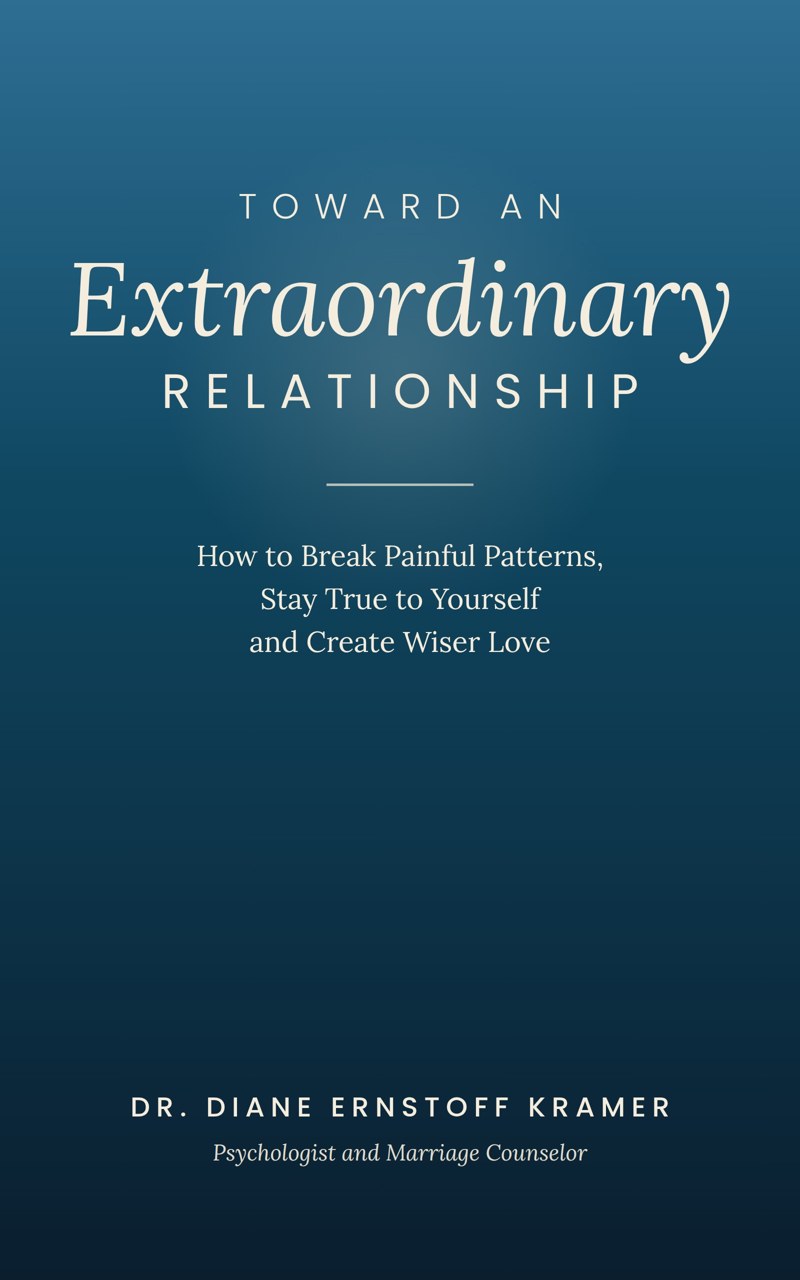 The book is about 140 pages, written in plain language, and a client can read a chapter in twenty minutes. Each chapter ends with a set of journal questions, worked through with one real moment from the client’s own relationship, so what they bring to the next session is specific rather than general. The first question in the book is: “What conflict, silence, or distance keeps repeating in my relationship?” A reader who no longer lives with the partner can work the questions with whatever contact remains.
The couples in the book are composites drawn from all those years of practice: people of many ages and races, dating, engaged, married and unmarried, straight and gay, many where one partner had had an affair, and many who were leaving a relationship or had already left one. In a fair number of those couples, one partner had been sexually abused in childhood.
The first seven chapters move from what happens between two people to what happens within each person, uncovering the root of the person’s part in the Cycle, and then back through practical change methods into the relationship. Chapter 8 turns to the relationship with the self: the Inner Judge, the Inner Coach, and the steady sense of being basically okay that the book calls Blue Sky.
Chapter 9, Hold or Fold?, helps the reader weigh what the relationship is showing them now, which is often the question a client is most afraid to ask. The work on your own part holds up whether the couple stays together or separates, and the book treats both as honest outcomes.
The appendices give the reader more patterns and beliefs to work with, and give you a note on where the framework sits among the approaches you already use. The book stands on its own; a reader needs no group and no account to use it.
The simplest way to decide whether the book belongs in your practice is to read the first chapter. It is free, and it takes twenty minutes.
The book comes to Amazon in the middle of November: paperback $17.95, Kindle $9.99, and $0.99 for the Kindle edition in its first month. An audio edition is planned for after the launch. Until then, the free chapter is what there is to hand a client.
I began as a research psychologist, with a Ph.D. from New York University, and in 1974 I recertified as a clinical psychologist and was licensed in New York State. For the next five decades I worked with individuals, couples, and families, trained as a divorce mediator, and taught psychology at Nassau Community College and Empire State College, State University of New York, retiring as a full professor. I am now professor emeritus, retired from practice, and living in South Carolina.
The Extraordinary Self Program came before the book. It began in 2008 as a face-to-face program. A very preliminary, uncontrolled pilot with 51 participants, who rated themselves on twelve competencies before the program, after it, and six months later, showed improvement at follow-up; the full data are available on request.
Write to me and I will send you the sequence of the framework and the questions used at each step, without charge. You are welcome to use the journal questions with your own clients.
For clients who want more structure between sessions, the Extraordinary Self courses go deeper into the same abilities; they are described on the Courses page. Clients are also welcome in the private Facebook group, Toward an Extraordinary Relationship, where readers work through the book together and I answer questions myself.
I would be glad to hear from you: diane@extraordinaryself.com.
Warmly,
Diane Ernstoff Kramer, Ph.D.
Professor Emeritus, State University of New York